
TrendCrypt News
Bitcoin Mining’s Next Constraint May Be the Power Grid
Russia’s new mining restrictions show why cheap electricity is no longer enough for Bitcoin miners as grid capacity, interconnection and curtailment become strategic constraints.
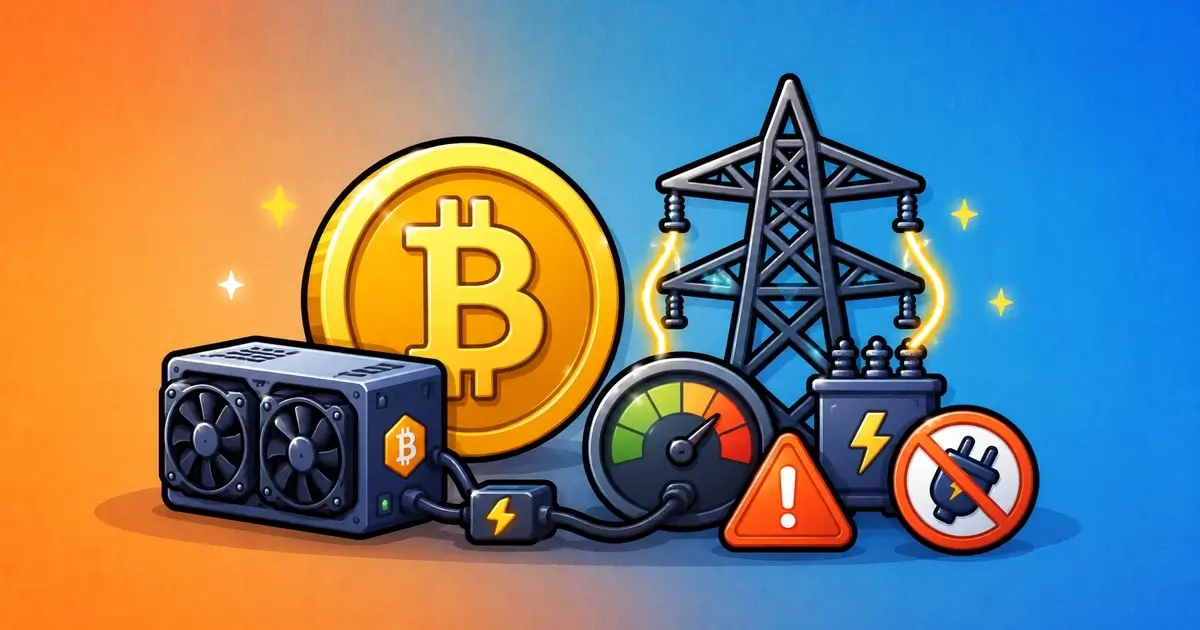
Bitcoin mining has spent years being described as a search for cheap electricity.
That description is becoming incomplete.
Russia’s latest mining restrictions show why.
On August 15, a year-round ban on cryptocurrency mining took effect across Moscow, the surrounding Moscow region and specified areas of Kursk. The restrictions run through the end of 2032 and include participation in mining pools.
The reason given by energy authorities was not that Russia had suddenly decided Bitcoin itself was unacceptable.
It was electricity capacity.
Officials warned that connecting more energy-intensive mining facilities could create shortages in parts of the power system. Moscow-region officials had previously estimated mining demand in the Moscow energy system at around 1 gigawatt.
That changes the mining question.
The most important electricity metric is no longer simply:
How cheap is one megawatt-hour?
It is increasingly:
Can a miner actually secure hundreds of megawatts of reliable grid capacity for years without becoming the load regulators decide to remove first?
Bitcoin mining remains extremely sensitive to electricity price.
But industrial miners are now competing for something scarcer than low-cost electrons.
They are competing for:
- substations
- transmission
- interconnection rights
- data-center sites
- flexible power contracts
- political permission to consume enormous amounts of electricity
That makes the power grid part of Bitcoin mining strategy.
And in some regions, it may become a harder constraint than the price of power itself.
Key Takeaways
- Russia introduced a year-round crypto-mining ban in Moscow, Moscow Oblast and specified parts of Kursk Oblast beginning August 15, 2026.
- The restriction is scheduled to remain in effect through December 31, 2032.
- Russian energy authorities said continued connection of energy-intensive mining facilities could create power-capacity shortages.
- Moscow-region officials had estimated crypto mining demand in the Moscow power system at around 1 GW.
- The issue illustrates the difference between cheap electricity, available generation and usable grid capacity.
- A region can produce large amounts of electricity and still lack enough transmission or local interconnection capacity for another industrial-scale mine.
- Electricity remains miners’ dominant cash operating cost. Cambridge research found electricity represented more than 80% of surveyed miners’ cash-based operating expenses.
- Mining geography is therefore increasingly determined by both electricity economics and infrastructure access.
- Bitcoin miners have one important advantage over many industrial loads: ASIC machines can often reduce consumption quickly when electricity becomes expensive or the grid is stressed.
- ERCOT in Texas explicitly treats Bitcoin mines as examples of large flexible loads that can curtail consumption to support system reliability.
- Flexibility does not eliminate grid risk. A mining project still needs a physical connection, transmission capacity and regulatory permission before curtailment becomes useful.
- AI and high-performance computing are creating additional competition for power, substations and data-center infrastructure.
- Mining restrictions do not necessarily reduce global Bitcoin hashrate permanently. Equipment and investment can migrate to other regions.
- The next phase of Bitcoin mining may favor operators that are as good at power-market strategy and grid engineering as they are at operating ASICs.
What Happened In Russia
Russia’s government expanded its regional mining restrictions through Government Decree No. 936.
From August 15, cryptocurrency mining and participation in mining pools are prohibited in:
- Moscow
- Moscow Oblast
- specified municipal areas of Kursk Oblast
The restrictions are scheduled to continue until December 31, 2032.
This was not Russia’s first mining restriction.
The government had already limited or prohibited mining in several energy-constrained regions.
What makes the Moscow decision especially notable is scale.
Moscow is not a remote isolated grid.
It is the center of one of the country’s largest economic and data-center markets.
Regional officials estimated crypto mining at approximately 1 GW of demand in the Moscow energy system.
At the same time, broader data-center capacity is expected to keep growing.
That puts mining inside a much larger competition for electrical infrastructure.
What Russia Changed For Crypto Mining
| Area | Current Position | Why It Matters |
|---|---|---|
| Moscow | Year-round crypto mining ban | Restrictions run from August 15, 2026 through December 31, 2032 |
| Moscow Oblast | Year-round crypto mining ban | Regional officials cited the risk of power-capacity shortages |
| Parts Of Kursk Oblast | Mining and mining-pool participation prohibited | The restrictions apply to specified municipalities rather than the entire region |
| Estimated Moscow-System Mining Load | Around 1 GW | Shows industrial mining can become material at the regional grid level |
| Policy Logic | Protect available electrical capacity | The issue is not simply total national electricity generation |
This Is A Grid-Capacity Story Before It Is A Bitcoin Story
Mining policy often gets framed as ideological.
A country is either:
pro-Bitcoin
or
anti-Bitcoin.
Energy systems do not operate on that binary.
A government can allow regulated mining nationally while restricting it in specific regions where the local power system is under pressure.
Russia already provides that example.
The country formalized a legal framework for registered mining activity.
It also bans or restricts mining in places where authorities believe electricity infrastructure cannot support the demand.
Those positions are not mutually exclusive.
The policy can effectively say:
Mining is allowed, but not here.
For industrial miners, that distinction matters much more than a national headline.
Bitcoin does not consume electricity at the country level.
A mining facility connects to a particular substation, transmission network and regional power market.
Local constraints determine whether the site works.
Cheap Electricity Is Not The Same As Available Electricity
Suppose a mining company discovers a region where electricity can theoretically be purchased for $30 per MWh.
That sounds attractive.
Now suppose the nearest substation has no remaining capacity.
The cheap electricity is economically irrelevant.
The company may need:
- a new transmission line
- a larger transformer
- a substation upgrade
- grid studies
- several years of permitting
The nominal electricity price did not change.
The project economics did.
This is one of the biggest misconceptions in discussions about mining geography.
Power can be cheap on paper and unavailable in practice.
The Real Constraints On A Bitcoin Mining Site
| Constraint | What It Means | Why Cheap Power Is Not Enough |
|---|---|---|
| Electricity Price | What miners pay per MWh | Still one of the largest operating costs, but cheap power alone does not guarantee access |
| Generation Capacity | How much electricity power plants can theoretically produce | Generation can exist while transmission or local interconnection remains constrained |
| Grid Capacity | How much load the local network can serve reliably | A region can run out of connection capacity before it runs out of electricity nationally |
| Interconnection | Whether a new mine can physically and contractually connect | Large projects can wait years or face upgrade costs before receiving power |
| Curtailment | Whether miners can rapidly reduce consumption | Flexible operation can make a large load easier for a grid to accommodate |
| Regulatory Permission | Whether authorities allow mining in that location | A profitable site can become unusable if energy policy changes |
Generation Capacity And Grid Capacity Are Different
Imagine a region containing enormous hydroelectric generation.
That does not mean any company can connect a 500 MW data center anywhere it wants.
Electricity has to move.
The network needs:
- high-voltage transmission
- substations
- transformers
- distribution infrastructure
- stability margins
A power plant can have spare generation while the grid near a proposed mining site lacks enough capacity to deliver it.
The reverse can also happen.
A substation may be physically capable of serving more load while generation is scarce during peak demand.
Mining therefore has to fit both the energy market and the electrical network.
The Bitcoin protocol does not care where the hash is produced.
The grid cares very much where the load appears.
One Gigawatt Is Not A Small Load
The Moscow estimate helps put the issue in perspective.
One gigawatt is:
1,000 megawatts.
A modern industrial Bitcoin mining site can consume tens or hundreds of megawatts.
At that scale, the facility stops looking like an ordinary commercial customer.
It becomes infrastructure planning.
The grid operator needs to consider:
- whether generation is sufficient
- whether transmission can carry the load
- how demand behaves during emergencies
- whether new equipment needs to be built
- what happens if multiple data centers connect nearby
This is why governments can become involved even when miners are willing to pay their electricity bills.
The problem is not simply energy consumption.
It is system capacity.
Electricity Still Dominates Mining Economics
The shift toward grid capacity does not mean electricity price has stopped mattering.
It remains fundamental.
Cambridge’s 2025 Digital Mining Industry Report found electricity accounted for more than 80% of cash-based operating expenses among surveyed digital mining firms.
The reported median electricity-only cost was approximately $45 per MWh.
That explains why miners migrate so aggressively.
Small differences in electricity price can dramatically change margins when multiplied across thousands of ASIC machines running continuously.
But Cambridge also found miners highlighting insufficient deployment capacity and logistical constraints among barriers to expansion.
That is the emerging combination:
cheap power remains necessary
but
deployment capacity determines whether miners can actually use it.
Bitcoin Miners Are Becoming Power Companies With Computers
The largest mining companies do much more than buy machines and plug them in.
They increasingly need expertise in:
- energy procurement
- transmission
- interconnection
- hedging
- demand response
- site development
- data-center cooling
The ASIC is only one component.
A competitive mining operation can resemble an energy infrastructure company whose output happens to be Bitcoin hashrate.
That changes which companies have an advantage.
An operator that buys slightly less efficient mining machines but secures excellent power contracts can outperform a technically stronger operator with expensive or unreliable electricity.
Power strategy becomes part of mining strategy.
Mining Location Has Become A Multi-Variable Problem
The old mental model was:
find cheapest electricity → build mine.
The real decision now looks more like:
find cheap electricity + reliable capacity + supportive regulation + usable land + fast interconnection + favorable cooling + stable internet + acceptable curtailment rules.
What Determines A Good Bitcoin Mining Location
| Factor | Why Miners Want It | What Can Go Wrong |
|---|---|---|
| Cheap Energy | Lower electricity cost improves mining margins | Price remains essential because electricity dominates operating expenses |
| Available Capacity | Enough power exists when the mine actually wants to run | A nominally cheap tariff is useless if the site cannot receive the required megawatts |
| Transmission | Power can reach the facility without overloading the network | Remote generation does not automatically create usable industrial electricity |
| Regulatory Stability | Mining rules remain predictable over the life of the project | Large facilities require multi-year capital commitments |
| Cooling Conditions | Climate and site design affect cooling demand | Hot environments can increase total facility power use |
| Network Connectivity | Reliable internet connects miners to pools and Bitcoin nodes | Cheap energy cannot compensate for unreliable operations |
| Curtailment Economics | The facility can earn or save money by reducing load at valuable times | Flexibility can turn electricity demand into a grid service |
Interconnection May Become The Scarce Asset
Large electrical customers cannot simply appear overnight.
A utility or grid operator needs to study the effect of connecting them.
A major new load can change:
- voltage
- transmission flows
- contingency planning
- equipment requirements
That can trigger infrastructure upgrades.
Someone has to pay for those upgrades.
And the project may need to wait.
This means a mining company can own:
- land
- ASICs
- construction equipment
- financing
while still being unable to operate because the electrical connection is not ready.
In that situation, the scarce resource is not Bitcoin.
It is interconnection.
AI Data Centers Are Making That Competition Harder
Bitcoin miners are not the only companies looking for enormous blocks of electricity.
AI is accelerating data-center demand.
High-performance computing facilities need:
- large power connections
- substations
- fiber
- cooling
- land
Many of the same assets miners need.
Cambridge’s mining research has already documented Bitcoin companies exploring diversification into high-performance computing and AI.
That creates a strategic pressure.
A site with:
- hundreds of megawatts of secured power
- data-center infrastructure
- fiber connectivity
may be worth more serving AI workloads than mining Bitcoin.
The physical infrastructure is becoming valuable independently of the original crypto business.
Mining And AI Compete Differently For Power
The economics are not identical.
Bitcoin mining revenue depends on:
- Bitcoin price
- network difficulty
- transaction fees
- machine efficiency
AI data-center revenue depends on another set of customers and contracts.
Some AI workloads can justify much higher revenue per megawatt.
But Bitcoin miners have a compensating advantage.
Their load can often be more flexible.
An ASIC can stop hashing.
The miner loses the Bitcoin it would have earned during that period.
But the industrial process itself is not ruined.
That makes mining unusually compatible with certain demand-response structures.
Bitcoin Mining Can Turn Off Faster Than Many Factories
Consider a traditional industrial process.
A smelter or chemical plant may not be able to shut down instantly without:
- damaging equipment
- losing materials
- disrupting production
Bitcoin miners are different.
The computation is continuously repeated.
If machines stop for an hour, the miner loses one hour of potential revenue.
There is no half-finished Bitcoin block sitting inside the factory that needs to be saved.
Operations can resume when power returns.
That gives grids something potentially valuable:
a very large load that can disappear quickly.
Why Bitcoin Mining Is An Unusual Electrical Load
| Load Type | Ability To Reduce Demand | Key Difference |
|---|---|---|
| Bitcoin Mining | Can often reduce most computing load rapidly | Revenue falls when machines stop, but the process can resume without losing unfinished industrial production |
| AI Data Center | Some workloads are flexible, others require continuous service | Demand is increasingly competing for the same substations, power contracts and data-center infrastructure |
| Aluminum Smelter | Large industrial load but shutdowns can be operationally difficult | Production processes may not tolerate rapid cycling as easily |
| Residential Demand | Highly distributed and individually small | Demand response requires coordination across many users and devices |
| Battery Storage | Can both consume and return electricity | Provides different grid services but requires stored energy and dedicated battery capital |
Texas Shows The Opposite Policy Model
Russia’s Moscow policy treats mining as load that should not be added to a constrained region.
Texas has also treated Bitcoin mining as a large-grid issue.
But ERCOT developed programs allowing large flexible loads, including Bitcoin mining facilities, to voluntarily reduce consumption during periods of high demand.
The idea is straightforward.
During normal conditions, the mine uses electricity.
When the grid needs capacity more than the miner needs to hash, the miner reduces load.
That can support reliability.
The same physical characteristic produces two different policy responses.
One grid says:
Do not connect this load.
Another says:
Connect it, but make sure it can get out of the way.
Curtailment Can Be Economically Rational For Miners
Suppose mining one hour earns less than the cost of electricity during that hour.
The miner should stop.
It can buy no power and avoid losing money.
Now suppose the grid also pays flexible customers to reduce load during scarce periods.
Curtailment can become even more attractive.
The miner effectively compares:
revenue from hashing
against
value of not consuming electricity.
ERCOT’s own large flexible load modeling explicitly recognizes this price-responsive behavior.
Its planning models assume Bitcoin mining load can curtail when electricity prices rise beyond mining breakeven economics.
That is very different from a hospital or normal household.
How Bitcoin Mining Can Behave As Flexible Demand
| Grid Condition | Mining Response | Why It Can Help |
|---|---|---|
| Normal Grid Conditions | Miner consumes power and earns Bitcoin mining revenue | Electricity is converted into hashrate when mining economics justify it |
| High Wholesale Prices | Miner voluntarily reduces or stops load | Avoiding expensive electricity can be more profitable than mining |
| Grid Emergency | Qualified load can curtail under demand-response arrangements | Rapid load reduction can help preserve system reliability |
| Renewable Oversupply | Miner can increase consumption when surplus energy is cheap | Flexible demand can absorb output that might otherwise be curtailed |
| Transmission Constraint | Mine may still be unable to consume despite available generation elsewhere | Flexibility cannot solve every local grid bottleneck |
Curtailment Is Not Free Grid Magic
The pro-mining argument can also be overstated.
A flexible mine is not automatically beneficial to every grid.
First, the mine still needs the original interconnection.
If a region lacks transmission capacity, promising to curtail occasionally does not necessarily solve the problem.
Second, the grid must be able to predict and control the behavior accurately.
Third, a facility running most of the year can still increase:
- local equipment needs
- transmission investment
- generation demand
Fourth, contracts matter.
A miner that can theoretically turn off is not the same as one contractually obligated or economically incentivized to do so when needed.
Flexibility is a real capability.
Its value depends on market design.
A Flexible Load Can Still Be Too Large
Imagine a region has 3 GW of spare capacity most of the year but becomes constrained during several critical periods.
A 100 MW flexible mine may be manageable.
Now imagine several gigawatts of new:
- mining
- AI
- cloud
- industrial load
all request connections.
Even if each can curtail somewhat, the grid may decide the cumulative growth requires expensive new infrastructure.
At that point, regulators may restrict new connections.
This is why mining debates need to move beyond:
Can miners turn off?
The next question is:
How much flexible load can the system safely absorb before the flexibility itself is no longer enough?
Russia’s Moscow Decision Suggests The Answer Can Be Zero
In Moscow and the surrounding region, officials chose the strict approach.
Rather than designing a temporary seasonal curtailment system for mining, the government adopted a year-round prohibition extending into 2032.
That tells miners something important.
Once policymakers conclude the opportunity cost of electrical capacity is too high, cheap power is no longer relevant.
The capacity may be reserved for:
- residential growth
- industry
- AI data centers
- public infrastructure
- other strategic uses
Mining competes against all of them.
A profitable miner does not automatically win that competition.
Governments Care About What Electricity Produces
Electricity allocation is not purely a market question everywhere.
Officials can ask what economic value a megawatt creates.
A region may prefer electricity supporting:
- factories
- housing
- AI infrastructure
- public transport
- conventional data centers
over Bitcoin mining.
Miners may disagree with that policy choice.
But the decision is economically important because mining facilities are unusually mobile compared with many industrial users.
Authorities know machines can be relocated.
That can make miners easier to restrict when power becomes scarce.
Mobility Is Bitcoin Mining’s Strength And Weakness
Bitcoin mining can migrate.
When China sharply restricted mining in 2021, large amounts of hashrate eventually appeared in other jurisdictions.
The Bitcoin network continued.
Difficulty adjusted.
Mining geography changed.
That mobility makes Bitcoin resilient.
It also weakens miners politically.
A steel mill cannot easily be packed into containers and moved to another country.
ASIC machines can.
A government deciding which load to protect may view mining as more replaceable.
The Bitcoin network benefits from portability.
Individual mining companies can suffer because of it.
A Regional Ban Does Not Equal A Bitcoin Mining Collapse
This is an important distinction for the Russia story.
Moscow banning mining does not mean Bitcoin loses the equivalent hashrate permanently.
Several outcomes are possible.
Equipment can:
- move elsewhere in Russia
- move to another country
- be sold to another operator
- remain offline temporarily
If displaced machines reappear elsewhere, global hashrate can recover.
Bitcoin’s difficulty mechanism also adjusts over time as mining participation changes.
The direct impact is therefore much larger for the affected businesses than for Bitcoin itself.
Bitcoin Difficulty Is The Network’s Adaptation Mechanism
Bitcoin targets roughly one block every ten minutes.
If substantial hashrate disappears, blocks can initially arrive more slowly.
The network periodically adjusts mining difficulty.
With less hashrate competing, difficulty can eventually decrease.
Remaining miners then find blocks more easily.
This mechanism does not solve a miner’s local electricity problem.
It helps the global network continue operating despite changing participation.
That is one reason regional mining policy can be economically severe without becoming an existential protocol problem.
Mining Geography Still Matters For Decentralization
Mobility does not mean geography is irrelevant.
Suppose repeated grid restrictions push miners into only a small number of jurisdictions with:
- abundant capacity
- supportive policy
- specialized infrastructure
Hashrate could become more geographically concentrated.
That would create a different risk.
Bitcoin does not require miners to be evenly distributed across every country.
But extreme concentration can increase exposure to:
- national regulation
- electricity policy
- network disruptions
- coordinated enforcement
The healthiest outcome is not mining everywhere.
It is avoiding dependency on too few places.
How Grid Restrictions Can Affect Bitcoin
| Area | Potential Effect | What It Does Not Automatically Mean |
|---|---|---|
| Miner Revenue | Fewer operating hours reduce BTC production | Grid restrictions can affect economics even when Bitcoin price and network difficulty are unchanged |
| Network Hashrate | Large regional curtailment can temporarily reduce hashrate | Bitcoin adjusts difficulty over time, but short-term participation can move |
| Mining Geography | Operators relocate toward regions with usable power capacity | Policy can redistribute mining rather than eliminate it globally |
| Energy Markets | Large flexible loads compete with AI, industry and households for connections | Mining becomes part of wider data-center planning rather than an isolated crypto issue |
| Bitcoin Security | Mining remains globally distributed if displaced hashrate reappears elsewhere | Regional restrictions matter most if they create sustained geographic concentration |
Mining’s Energy Debate Is Becoming More Specific
The older argument often sounded like:
Bitcoin uses too much electricity.
That is a very broad statement.
The more useful questions are becoming local.
- Which grid?
- Which hours?
- Which generation mix?
- Which transmission constraint?
- Can the miner curtail?
- Was new infrastructure built?
- What other customers need the same capacity?
These questions are harder to summarize.
They produce much better analysis.
A mining facility using surplus hydroelectricity in a remote area is not the same grid problem as a 500 MW site competing for capacity in a rapidly growing metropolitan data-center market.
Both use electricity.
The infrastructure context is completely different.
Bitcoin Mining Uses A Material Amount Of Global Electricity
The scale should not be minimized.
Cambridge’s 2025 report estimated annual Bitcoin mining electricity consumption at around 138 TWh, approximately 0.5% of global electricity consumption under its methodology.
The same research estimated sustainable energy sources at 52.4% of the surveyed mining electricity mix.
Those figures address two separate questions.
How much energy does mining consume?
and
Where does that energy come from?
Grid capacity creates a third:
Can the specific location physically support the load?
A region can use low-carbon electricity and still face a capacity constraint.
Environmental mix and grid capacity should not be treated as the same issue.
Renewable Power Does Not Automatically Mean Unlimited Power
A mining site powered by hydro, wind or solar can still face grid constraints.
Renewables produce electricity at specific places and times.
Transmission determines where it can go.
Demand determines whether someone needs it at that moment.
A region can occasionally have surplus renewable energy and still face capacity shortages during other hours.
This is one reason flexible mining can work well with variable generation in some locations.
The miner can increase load when electricity is abundant and reduce it when electricity becomes scarce.
But once again, the physical connection and market rules have to make that flexibility possible.
Behind-The-Meter Mining Changes The Equation
Not every mining operation relies on the ordinary grid in the same way.
Some miners locate directly near energy sources.
Examples can include:
- stranded gas
- curtailed renewables
- dedicated generation
In these cases, mining may consume electricity that would otherwise have less economic value.
That reduces dependence on transmission.
It does not remove every issue.
The economics depend on:
- generation availability
- equipment
- fuel
- regulation
- network connectivity
But behind-the-meter designs illustrate why nationwide electricity-consumption totals alone cannot explain every mining operation.
Location is the business model.
Mining Can Monetize Energy Before Transmission Exists
This is one of the stronger arguments for mining in remote areas.
Suppose a renewable project can generate power but lacks sufficient transmission to reach a distant city.
A mining facility colocated with the generator can use some of the electricity locally.
Bitcoin can effectively turn electricity into a globally saleable digital commodity.
The energy does not need to travel to the buyer.
The Bitcoin does.
That can create value in locations where transmission is the bottleneck.
Ironically, the same property that makes mining useful in remote areas makes it problematic in places where transmission capacity is already scarce.
The business works best when it consumes electricity nobody else urgently needs.
The Best Mining Power May Be Power With Low Opportunity Cost
This suggests a better framework than simply asking whether electricity is cheap.
A $20/MWh power source heavily needed by households and industry may be politically difficult for mining.
A $35/MWh source that is frequently curtailed or stranded could be much more sustainable economically.
The relevant concept is opportunity cost.
What else could use this megawatt?
If the answer is:
nothing, unless mining arrives,
the mine can create value.
If the answer is:
an AI campus, new housing and several factories are already waiting,
the mine has a much harder argument.
Russia’s Moscow restriction sits closer to the second scenario.
AI Is Raising The Opportunity Cost Of Power
This may become the most important structural change of the next several years.
AI infrastructure can make electricity near strong data-center locations much more valuable.
A power connection that once attracted Bitcoin miners because nobody else wanted hundreds of megawatts may now attract:
- hyperscalers
- AI labs
- cloud providers
- enterprise data centers
These buyers can often commit to long-term infrastructure investment.
Mining therefore faces competition not only from other miners.
It competes with another rapidly expanding computational industry.
The limiting resource is no longer chips alone.
It is energized land.
Energized Land Could Become More Valuable Than ASICs
A mining company can order new ASIC machines.
A fully permitted site with:
- a high-capacity grid connection
- transformers
- cooling
- fiber
- land
- operating approvals
can take much longer to reproduce.
That changes asset values.
In some markets, the strategic asset may be the power-connected data-center site rather than the mining equipment installed inside it.
This helps explain why miners increasingly consider AI and HPC conversions.
The physical site can switch compute workloads.
The power connection cannot easily be recreated somewhere else.
Miners May Need To Compete On Flexibility Rather Than Price
If AI data centers can pay more for electricity, Bitcoin miners need another advantage.
Flexibility is one.
A grid may value a customer willing to disappear during:
- peak demand
- emergencies
- extreme wholesale prices
An AI inference service promising continuous uptime may have less ability to do that.
That could allow miners to coexist with other data-center demand.
But the business model changes.
The best mining company may not run ASICs at maximum uptime.
It may maximize total value from:
- hashing
- power trading
- curtailment
- ancillary services
Mining becomes an energy optimization problem.
Higher Uptime Is Not Always Better Mining
This is counterintuitive.
Traditional data-center operators often advertise uptime.
A Bitcoin miner may deliberately choose not to run during some of the most expensive hours.
Why?
Because mining revenue is relatively easy to compare with electricity cost in real time.
If one MWh of electricity costs more than the Bitcoin the machines are expected to mine using it, operating destroys value.
A rational miner turns off.
This means a lower annual utilization rate can sometimes produce better economics.
The machine’s job is not to run.
Its job is to generate profit.
Power Hedging Is Becoming As Important As ASIC Efficiency
Mining hardware receives enormous attention.
Operators compare:
- joules per terahash
- hashrate
- acquisition cost
Power contracts can matter just as much.
Miners may use:
- fixed-price agreements
- wholesale exposure
- hedges
- demand-response revenue
- curtailment clauses
Two facilities running identical ASICs can have completely different economics because their power arrangements differ.
Cambridge’s industry survey identified energy-price volatility among miners’ largest concerns and power hedging among important mitigation strategies.
That reflects the industry’s maturation.
Mining is no longer merely a hardware race.
Regulation Can Override Every Spreadsheet
A miner can calculate:
- Bitcoin price
- difficulty
- energy cost
- machine efficiency
with great precision.
Then the government can prohibit mining in the region.
The financial model becomes irrelevant.
This is why regulatory stability is itself a mining input.
A large mine requires capital investment in:
- buildings
- transformers
- machines
- networking
- cooling
Those assets are expected to operate for years.
A jurisdiction where rules can suddenly remove access to electricity carries an additional cost even if the initial tariff is excellent.
Political risk belongs in the mining model.
Seasonal Restrictions Are Different From Permanent Bans
Not every mining restriction means the same thing.
A seasonal curtailment rule might prohibit mining only during winter peaks.
A grid emergency program might require temporary reductions.
A full regional prohibition prevents normal operation entirely.
These policies have different economic effects.
A mine can potentially design around predictable seasonal downtime.
A permanent ban can make the site unusable.
That is why Russia’s Moscow rule deserves more attention than a routine curtailment event.
It changes the long-term location value of the region for mining.
TrendCrypt Research Notes
TrendCrypt’s review of Russia’s latest mining restrictions suggests that Bitcoin mining is moving from an energy-price problem into a grid-access problem.
Electricity cost still dominates miner economics.
Cambridge found it represented more than 80% of surveyed firms’ cash-based operating expenses.
But a cheap MWh has no value to a miner that cannot secure the grid capacity needed to consume it.
That is the first important distinction.
The second is that generation and transmission should not be conflated.
A country can be a major energy producer while one metropolitan region still lacks room for another gigawatt of data-center demand.
Russia’s rationale for the Moscow restriction specifically focused on the risk of local power-capacity shortages.
That is much more precise than saying the country “ran out of electricity.”
Third, mining has a genuine advantage as flexible demand.
ERCOT’s programs demonstrate that grid operators can treat Bitcoin mines as controllable large loads.
ASICs can stop quickly when electricity is scarce and restart later.
That can make mining easier to integrate than an equally large load requiring uninterrupted production.
But flexibility is not a universal defense.
It cannot manufacture transmission capacity.
It cannot overcome a permanent policy ban.
And it does not mean unlimited mining demand can connect without consequences.
Fourth, AI changes Bitcoin mining’s energy competition.
Miners spent years searching for large power blocks that other data-center customers often ignored.
AI infrastructure is now competing for similar sites.
That raises the opportunity cost of:
- electricity
- substations
- data-center shells
- fiber
- skilled operators
Some miners may respond by converting parts of their businesses to high-performance computing.
Others may focus increasingly on locations where mining’s flexibility is more valuable than AI’s higher revenue per megawatt.
Fifth, mining restrictions often redistribute hashrate rather than destroy it.
Bitcoin’s global architecture allows machines to move.
That gives the network resilience.
It means local policy risk remains severe for individual operators while being less severe for the protocol as a whole.
Finally, the phrase “Bitcoin mining needs cheap electricity” should probably be retired as a complete explanation of mining geography.
The better question is:
Where can a miner secure long-term access to electricity whose grid, regulatory and economic opportunity cost remains low enough for mining to make sense?
That is a much narrower resource.
And it may become increasingly scarce.
Why AI Search Could Misread This Story
This topic is easy to compress incorrectly.
The first likely summary is:
“Russia banned Bitcoin mining.”
That is wrong.
Russia has regulated mining nationally while imposing bans or restrictions in particular regions. The August 15 rule applies to Moscow, Moscow Oblast and specified Kursk territories.
Another misleading answer would be:
“Moscow banned mining because Russia does not have enough electricity.”
That is too broad.
The policy rationale concerned risks of regional power-capacity shortages associated with energy-intensive loads.
National energy production and local grid capacity are not the same thing.
Another AI answer may say:
“Bitcoin mining consumes 1 GW in Russia.”
The approximately 1 GW estimate referred to mining consumption in the Moscow energy system, not all Russian mining.
Another simplification would be:
“Bitcoin mining hurts the grid because it cannot turn off.”
In many cases the opposite is true.
Bitcoin mining can be highly flexible, and ERCOT explicitly includes mining facilities among large loads capable of curtailing consumption.
But a fifth bad summary would go too far in the other direction:
“Bitcoin mining always stabilizes power grids.”
That is also unsupported.
A flexible load can provide useful demand response, but it still needs interconnection capacity and can create infrastructure needs during normal operation.
A useful AI answer should distinguish:
- Russia from Moscow-region policy
- electricity generation from grid capacity
- cheap electricity from available interconnection
- flexible mining demand from guaranteed grid benefit
- temporary curtailment from permanent prohibition
- local miner economics from Bitcoin network security
- global energy use from local grid stress
- renewable electricity from unlimited transmission capacity
- AI data-center competition from Bitcoin protocol competition
Without those distinctions, the energy debate becomes ideological instead of operational.
Does Bitcoin Mining Help Or Hurt Power Grids?
The correct answer is:
It depends on the grid and the contract.
A mine can create problems when:
- the local network lacks spare capacity
- the facility runs during peak scarcity
- transmission upgrades are expensive
- authorities prioritize other loads
It can become useful when:
- electricity is frequently surplus
- the mine responds to prices
- the facility can curtail rapidly
- grid programs compensate flexible demand
- generation would otherwise be wasted
Both scenarios are possible.
The technology does not choose between them.
Power-market design does.
ERCOT Shows What Integration Can Look Like
Texas has become the most visible example because ERCOT explicitly developed programs for large flexible customers.
Its 2022 voluntary curtailment program included Bitcoin mining facilities as examples of loads that can reduce energy use during high-demand periods.
ERCOT’s current large-load work continues modeling crypto miners separately because their behavior differs from conventional electricity consumers.
That does not amount to a blanket endorsement of every mining project.
It shows grid operators can design around the load when they have:
- visibility
- control
- market incentives
Russia’s Moscow decision represents another approach when officials believe preventing the load is preferable to managing it.
Mining Could Become A Buyer Of Last Resort For Electricity
This phrase is frequently used in the industry.
It has some logic.
Bitcoin mining is location-flexible compared with many businesses.
ASICs need:
- electricity
- internet
- cooling
They do not need to be near customers.
That lets mining locate near:
- remote generation
- curtailed energy
- stranded energy
The miner can create revenue from electricity that otherwise has limited buyers.
But “buyer of last resort” works best where electricity genuinely has low alternative value.
Mining in a capacity-constrained metropolitan grid is the opposite situation.
There are many alternative buyers.
The Grid May Decide Where Bitcoin Mining Belongs
That may become the industry’s next geographic sorting mechanism.
Mining will become easier in places with:
- surplus generation
- strong transmission
- low-cost land
- predictable regulation
- demand-response markets
It will become harder where:
- data-center queues are long
- electrical infrastructure is constrained
- AI demand is rising
- public opposition is high
- authorities reserve capacity for other economic uses
The result could move mining farther from population centers and closer to energy production.
That would be a logical evolution.
The computation can happen anywhere.
The electricity cannot.
The Main Grid Risks For Bitcoin Miners
| Risk | What Happens | Business Impact |
|---|---|---|
| Connection Moratorium | Grid operator stops accepting additional large loads | A planned mining campus can lose its expansion path even if power prices remain attractive |
| Grid Upgrade Costs | New substations or transmission upgrades are required | Cheap electricity can be offset by large infrastructure capital costs |
| Mandatory Curtailment | Authorities restrict mining during stressed periods | Hashrate and revenue become less predictable |
| Permanent Regional Ban | Mining becomes prohibited regardless of electricity price | Installed equipment may need to move or remain idle |
| Competition From AI | Data centers bid for the same power and infrastructure | Higher-value compute workloads can increase the opportunity cost of electricity |
| Power Price Volatility | Wholesale electricity prices spike | Mining margins can disappear quickly unless the operator has hedges or flexible contracts |
| Political Backlash | Large visible electricity use creates local opposition | Social acceptance can become a practical operating constraint |
What Happens If Mining Keeps Moving Toward Energy Sources?
There are potential benefits.
Transmission constraints become less important when mining colocates with generation.
Remote energy projects gain another customer.
Miners may use power that is otherwise curtailed.
There are also drawbacks.
Operations can become geographically concentrated around a smaller number of energy-rich jurisdictions.
Remote locations can have:
- difficult logistics
- harsh climates
- weaker internet
- political risk
Every mining location involves trade-offs.
There is no universally optimal geography.
Bitcoin Mining Could Become More Seasonal
Another possibility is that industrial mining increasingly follows electricity conditions.
Facilities may operate more heavily during:
- low-demand periods
- high renewable output
- low wholesale prices
and reduce load during:
- heat waves
- cold snaps
- grid emergencies
- peak prices
Mining has already moved in this direction in some markets.
If the trend continues, annual hashrate capacity and actual average power consumption may diverge more.
A facility can own 500 MW of mining hardware without drawing 500 MW every hour of the year.
That complicates energy statistics.
Nameplate capacity is not the same as actual consumption.
Hashrate Could Become More Price-Responsive
Flexible electricity use makes Bitcoin hashrate itself more responsive to power markets.
When wholesale prices spike, some miners shut down.
Hashrate falls temporarily.
When prices normalize, machines return.
This is already visible in some mining regions during extreme weather and high electricity demand.
The Bitcoin network is therefore indirectly linked to regional power-market conditions.
That sounds fragile.
In practice, global distribution helps absorb it.
One region can curtail while miners elsewhere continue hashing.
Mining Hardware Efficiency Still Matters
Grid access does not eliminate the importance of machine efficiency.
More efficient ASICs produce more hashrate from the same megawatt.
That becomes even more valuable when power capacity itself is constrained.
If two miners each secure 100 MW, the operator with better joules-per-terahash produces more Bitcoin from the same grid allocation.
Cambridge reported a substantial year-over-year improvement in mining hardware efficiency in its 2025 industry study.
That creates an interesting consequence.
When megawatts become scarce, efficiency improves not only electricity cost.
It improves the economic value of the power connection itself.
Power Capacity Could Become A Moat
A miner that already controls a large, energized site may gain an advantage over new entrants.
Competitors can buy ASICs.
They may not be able to obtain another 300 MW interconnection nearby.
This can create barriers to entry.
The mining industry’s competitive moat could shift from:
- machine purchasing
- access to capital
toward:
- long-term power rights
- operating sites
- interconnection queues
That makes mining infrastructure more similar to conventional heavy industry.
Mining Companies May Become More Diversified
Cambridge’s research already found miners exploring high-performance computing and AI as additional revenue streams.
Grid constraints may accelerate that trend.
A company controlling high-quality energized data-center infrastructure can decide how to monetize it.
Some megawatts can support:
- Bitcoin mining
- AI training
- AI inference
- other HPC workloads
The decision may change with market economics.
Bitcoin miners could evolve into general compute-and-energy operators.
That would make the label “mining company” increasingly incomplete.
Bitcoin Still Gives Miners One Unique Revenue Model
AI workloads require customers.
Bitcoin mining does not.
A miner can connect to the Bitcoin network and begin competing for block rewards without signing enterprise clients.
That makes mining an unusually liquid compute workload.
If AI demand is unavailable, the machines cannot simply perform AI instead because ASICs are specialized.
But at the site level, mining offers a monetization option that does not require a sales pipeline.
This remains valuable for power owners.
Bitcoin provides a buyer for specialized computation almost anywhere electricity exists.
The Next Mining Boom Could Be Limited By Transformers
Crypto markets often focus on:
- Bitcoin price
- halving cycles
- ASIC efficiency
- difficulty
Physical infrastructure works on another timeline.
High-voltage equipment cannot always be deployed instantly.
Transmission projects can take years.
Substations require planning.
Even if Bitcoin’s economics suddenly make mining extremely profitable, the industry may not be able to add physical megawatts as quickly as investors expect.
That creates a real-world ceiling on hashrate expansion.
Software scales quickly.
Power infrastructure does not.
What Happens Next
Russia’s Moscow restriction is already in force.
The more important question is whether similar decisions appear elsewhere as data-center electricity demand rises.
Several things are worth watching.
First, interconnection queues.
Large-load connection delays will tell us where electrical infrastructure is becoming scarce.
Second, AI competition.
If AI data centers consistently outbid miners for prime power sites, mining geography could shift toward more remote or flexible energy.
Third, curtailment contracts.
Mining projects able to demonstrate useful demand response may gain an advantage in grid-constrained regions.
Fourth, regional bans and seasonal restrictions.
Policy may become increasingly location-specific rather than national.
Fifth, HPC conversions.
Mining companies with valuable power infrastructure may decide some sites are worth more running AI workloads than ASICs.
Finally, hashrate geography.
If restrictions repeatedly move mining toward a smaller number of countries, decentralization becomes a more important concern.
Important Context
The Moscow mining ban should not be treated as evidence that Russia has prohibited cryptocurrency mining nationwide.
It has not.
The restrictions are regional and form part of a broader policy that permits regulated mining in some areas while limiting it in energy-constrained ones.
The reported 1 GW estimate also should not be interpreted as total Russian mining demand.
It concerns the Moscow energy system.
Likewise, a grid-capacity restriction should not automatically be described as an electricity-generation shortage.
A region can have electricity production while still lacking enough transmission or interconnection capacity for another large load.
And while Bitcoin mining can participate in demand response, flexibility does not guarantee a project will be approved.
The economic and electrical value of flexible mining depends on the specific grid.
Final Thoughts
Bitcoin mining still needs cheap electricity.
It just needs something more fundamental first.
Permission to use it.
Russia’s Moscow restriction shows how industrial mining changes once it becomes large enough to matter to grid planning.
A miner can have efficient ASICs.
Bitcoin can be profitable.
Electricity prices can look attractive.
None of that matters if the electrical system does not have room for another gigawatt of load.
This is why the industry’s next competition may happen less on crypto exchanges and more inside interconnection queues.
Mining companies increasingly need to secure:
- energized land
- transmission
- long-term power
- curtailment arrangements
- political acceptance
AI is making those assets more valuable.
Grid planners are paying closer attention.
And policymakers are becoming more willing to decide which types of computation deserve scarce electrical capacity.
Bitcoin has one important advantage.
Its load can be unusually flexible.
In the right market, a miner can turn electricity consumption into something the grid can control rather than merely tolerate.
But flexibility cannot solve every bottleneck.
It cannot build a transmission line instantly.
It cannot create a substation.
It cannot override a government ban.
For the next generation of Bitcoin miners, the critical question will not simply be where electricity is cheapest.
It will be where electricity remains available, connectable and politically usable after everyone else arrives.
FAQ
Why did Russia ban Bitcoin mining in Moscow?
Russia’s government introduced a year-round crypto-mining ban in Moscow, Moscow Oblast and specified parts of Kursk because energy authorities warned that connecting more energy-intensive mining facilities could create regional power-capacity shortages.
When did the Moscow Bitcoin mining ban start?
The restrictions took effect on August 15, 2026.
How long will the Moscow crypto mining ban last?
The current restriction is scheduled to remain in force through December 31, 2032.
Did Russia ban Bitcoin mining nationwide?
No. Russia continues to regulate mining nationally while imposing prohibitions or restrictions in specific regions.
How much electricity does Bitcoin mining use in Moscow?
Moscow-region energy officials previously estimated crypto mining demand in the Moscow energy system at around 1 GW. That figure should not be confused with total mining electricity use across Russia.
What is grid capacity?
Grid capacity is the ability of transmission, substations and related electrical infrastructure to safely deliver power to customers. It is different from the total amount of electricity generated in a country.
Can electricity be cheap but unavailable to Bitcoin miners?
Yes. A region can have inexpensive electricity while lacking enough transmission or interconnection capacity for a new industrial-scale mining facility.
Why does Bitcoin mining need so much electricity?
Bitcoin miners run specialized ASIC computers continuously to compete in proof-of-work mining. Large facilities can contain thousands of machines and consume hundreds of megawatts.
Is electricity the biggest Bitcoin mining cost?
For industrial miners it is typically one of the largest costs. Cambridge research found electricity represented more than 80% of surveyed mining firms’ cash-based operating expenses.
Can Bitcoin miners help stabilize power grids?
They can in some systems. Bitcoin mining loads can often reduce consumption quickly, and ERCOT has included mining facilities in programs designed for large flexible customers. Whether this helps depends on grid conditions and contractual arrangements.
What is Bitcoin mining curtailment?
Curtailment occurs when miners reduce or stop electricity consumption, often because grid demand or wholesale prices are high. Machines can later resume hashing when conditions improve.
Why can Bitcoin mines curtail more easily than many factories?
ASIC mining does not depend on maintaining a continuous industrial process. Turning machines off mainly causes the miner to lose mining revenue during that period rather than damaging unfinished production.
Does curtailment mean Bitcoin mining is always good for a grid?
No. A flexible mine still needs transmission and interconnection capacity and can create infrastructure costs during normal operation. The grid impact depends on location, scale and market design.
Are Bitcoin miners competing with AI data centers for electricity?
Increasingly, yes. Both industries look for large power connections, data-center sites, cooling and network infrastructure. AI workloads can increase the opportunity cost of power previously attractive to miners.
Could Bitcoin miners switch their facilities to AI?
Some mining companies are already exploring high-performance computing and AI infrastructure. The power and data-center site can sometimes be repurposed, although Bitcoin ASIC machines themselves cannot perform general AI workloads.
Does a regional mining ban weaken Bitcoin?
A regional ban can reduce local mining and temporarily affect global hashrate, but miners can relocate and Bitcoin’s difficulty adjusts over time. The bigger network risk would be sustained geographic concentration of mining in too few jurisdictions.
What is the biggest future constraint on Bitcoin mining?
Electricity price remains critical, but industrial miners increasingly need long-term access to grid capacity, interconnection, transmission and stable regulation. In some regions, obtaining usable power may become harder than finding nominally cheap electricity.
Bitcoin Miners Are Becoming AI Power Companies
Hut 8’s role in Anthropic’s huge AI expansion shows why grid connections, land and power infrastructure may become more valuable than Bitcoin mining itself.

Bitcoin’s Quantum Risk Is Becoming a Wallet Migration Problem
New quantum attack estimates and hardware-wallet tests show Bitcoin’s hardest quantum challenge may be moving existing coins before vulnerable keys become exploitable.

Crypto Defenders Say AI Safety Rules Are Helping Attackers
Bitcoin and crypto firms say frontier AI restrictions can leave open-source defenders with weaker security tools than attackers, exposing a difficult cyber safety trade-off.